Membrane separation
Membrane separation is used to remove certain portions from a solution. The types of separation are distinguished according to the size of the membrane pores, in micro, ultra and nano-filtration, and reverse osmosis. Also electrodialysis is mentioned.
Objective
Membrane separation is aimed at the selective removal of water (and solutes and/or suspended material) from a solution by using semi-permeable membranes. Therefore it can also be seen as a fractionation technique. There are two membrane separation techniques used in the food industry: membrane filtration and electrodialysis.
Field of application
Membrane separation is applied for the concentration of liquids (for example with cheese whey), the demineralisation of whey or water, whey fractionation, and for water purification.
Techniques, methods and equipment
a) Membrane filtration
Membrane filtration is a pressure driven filtration technique in which a solution is forced through a porous membrane. Some of the dissolved solids are held back because their molecular size is too large to allow them to pass through, the size range depending upon the types of membranes used. Fractionation of the feed stream occurs, with some molecules being concentrated on the upstream side of the membrane, which is known as the concentrate or retentate, while the smaller molecules pass through the membrane into the permeate stream. The various membrane filtration techniques can be characterised by their membrane pore size (i.e. the size of the smallest particle that cannot pass through the membrane). For example milk component fractionation is characterised by the size of filter used, e.g.:
-
Micro Filtration (MF): ~0.1 µm to 5 µm the (MF) process can be used to remove bacteria from skimmed milk during the production of ultra clean milks, or for fractionation of the skimmed milk into a casein rich retentate and a milk serum devoid of casein.
-
Ultrafiltration (UF): ~10 – 100 nm range (UF) is applied to both skimmed milk and whey in order to concentrate the respective protein components.
-
Nanofiltration (NF): ~1 – 10 nm range (NF) membranes have selective permeability for minerals and some small organic/inorganic molecules, and are used predominantly for concentration and pre-demineralisation of whey.
-
Reverse Osmosis (RO): ~0.1 – 1nm range RO membranes are permeable to water but not minerals and are therefore used for dewatering, concentration of whey or skimmed milk, or for polishing NF permeates or evaporator condensate and in water treatment (softening/demineralisation).
b) Electrodialysis
Electrodialysis (ED) is membrane separation in the presence of an applied electro potential. In electrodialysis, low molecular weight ions migrate in an electrical field across cationic or anionic membranes. These membranes are alternately arranged between the cathode and anode within a stack. The principle application in the dairy industry is for the demineralisation of whey.
Why does Hiperbaric use Streamline HD (Hygienic Design)?
Mr. Raúl López Ondevilla (Mechanical engineer) explains:
“I heard from the Streamline HD solution thanks to Safe Food Factory and Wouter Burggraaf."
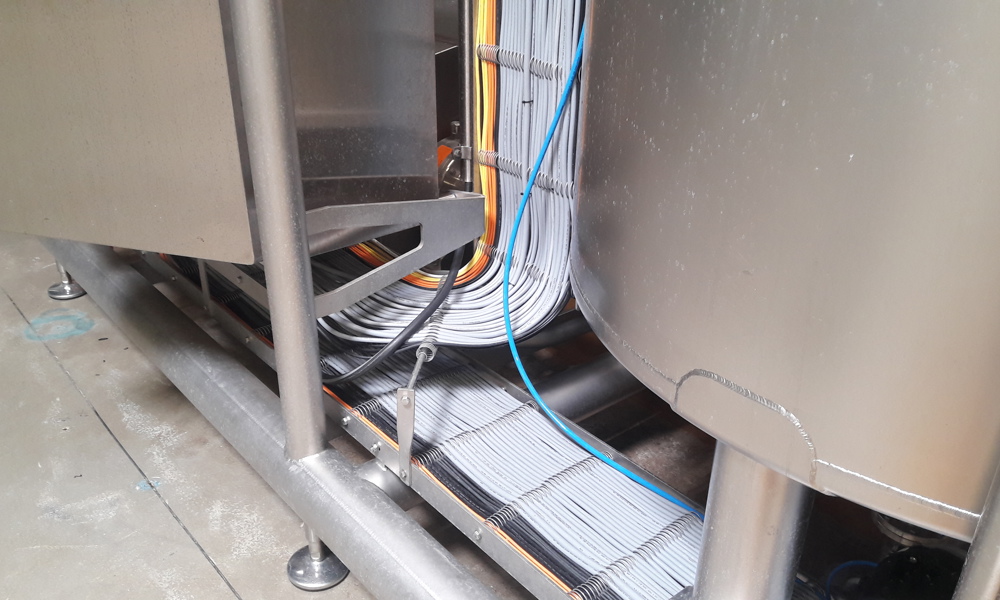
"The first reason to choose it was its hygienic aspect."
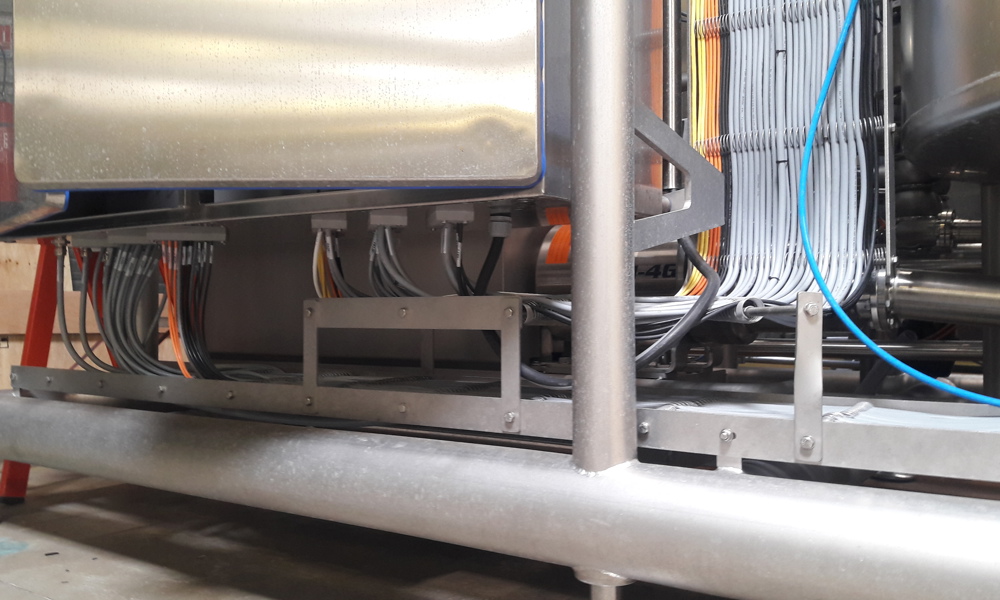
"The aesthetic result of the neatly displayed cables and flexible pipes was also a good point."
Proven in Practice
Raúl continues:
"The equipment final user did not trust much on this solution at first glance, the absence of cable ties can be a bit mind blowing. However, after a couple of years since their installation the system has proven its value."
"One of the biggest advantage I had not foreseen at the beginning is how easy and quick it is to change or add a cable to the system.”/
Featured expert: Michael Evers
