Looking back at the first cabling day
The kick-off of the working group Hygienic Cabling in the Food Industry.
A warm welcome was given at ROVC in Ede, where 116 participants attended the Cabling Workshop.
The opening was given by Michael Evers, secretary of EHEDG Netherlands. EHEDG aims to improve food safety and, to this end, to widely disseminate state-of-the-art technology. They want to take the lead in developing better solutions and not just stick to the "this is how we've always done it" approach.
On behalf of ROVC, Maartje Mikx welcomed the visitors and briefly explained that the Tech Academy Food can support food companies with practical training.
To address the questions, Mr. Beuger of the Netherlands Food and Consumer Product Safety Authority (NVWA) outlined the legislative principle: companies are responsible for food safety according to the target legislation, but they have the freedom to determine how they do this, which the NVWA will monitor.
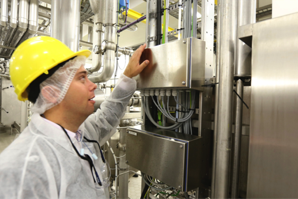
The practicalities and expectations of the food industry were explained by FrieslandCampina and Mead Johnson. FC is currently translating the EHEDG principles into QA standards through employee training, incorporating the guidelines into regulations, and establishing project groups. In upcoming projects, engineering will be handled according to EHEDG guidelines. A case study from Mead Johnson was presented: the questions surrounding a small preparation skid. By drawing the piping in 3D beforehand, the initial assessment could already be done on the drawing. However, some requirements remained: fewer cables per object, more space around equipment, and cables also in 3D.
Hago provided practical answers to questions about cleaning cabling: including how clean, which zone, where in relation to the line, and how they should be secured.
Mr. Burggraaf summarized and initiated the discussion: cables also pose a risk because they can be damaged, for example by rodents, because suspension leads to problems with moisture, dirt, or vermin, and because penetrations pose a safety or pest control problem.
This was followed by a discussion round, where small groups discussed various sub-areas: e.g., field or machine cabling, cable combinations, coding, and the need for specific legislation and regulations.
Finally, the meeting concluded with the larger group, explaining the working group's structure, and concluding with snacks and drinks.
